Order workflows
Review how orders move between sales, fulfilment, customer communication, reporting, and other systems to identify unnecessary manual steps.

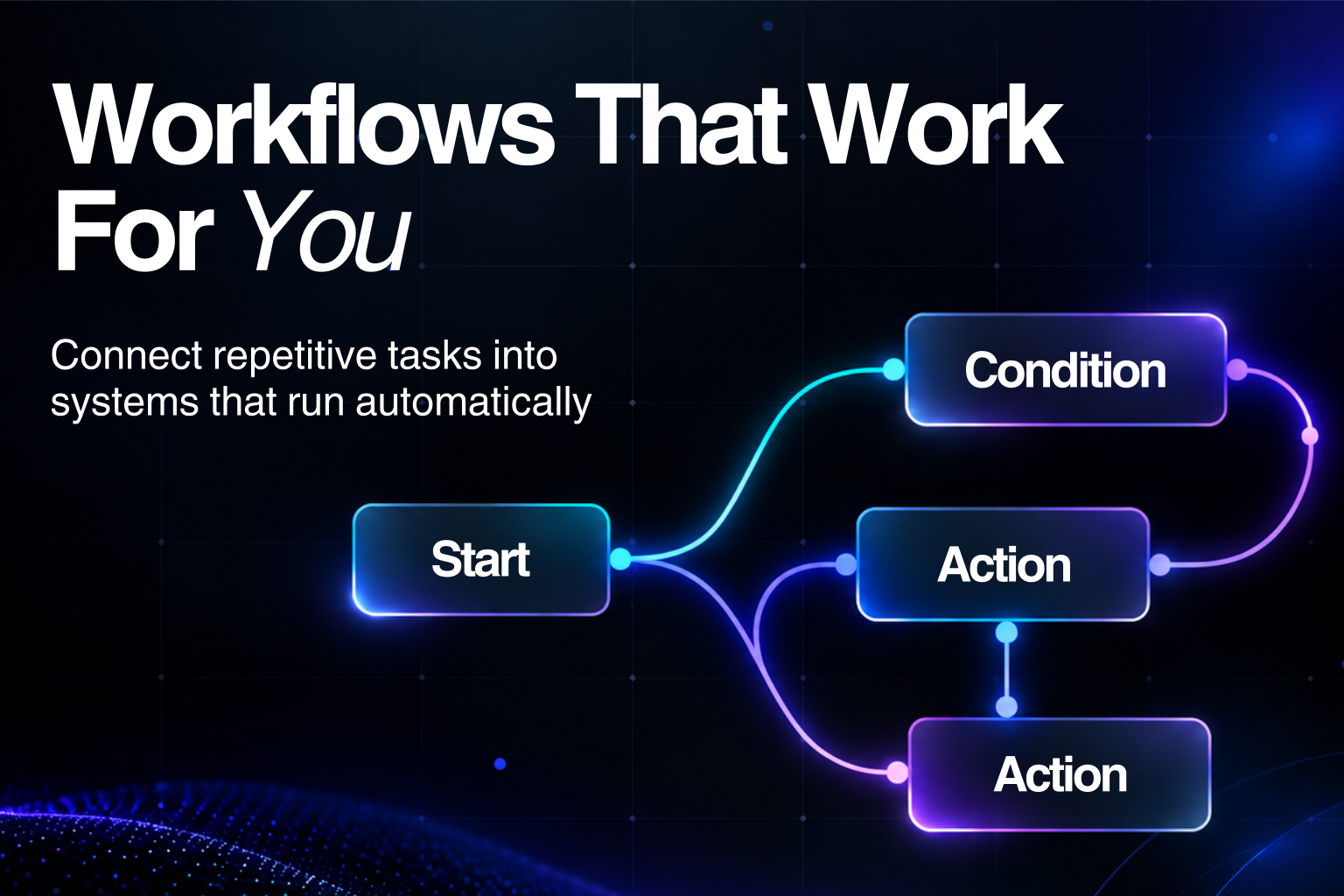
Systems & Automation
We help businesses identify repetitive processes, disconnected tools, and operational bottlenecks — then design practical systems and automation opportunities that help the business run more efficiently.
Automating the wrong process does not make a business more efficient.
Before introducing new tools, we look at how information currently moves through the business, where employees repeat work manually, where systems fail to communicate, and where unnecessary steps slow the operation down.
The goal is to identify where technology and automation can genuinely remove friction, improve consistency, and create a more efficient way of working.
What we review
We review how work moves through the business, where manual tasks are being repeated, and where better systems could simplify the process.
Review how orders move between sales, fulfilment, customer communication, reporting, and other systems to identify unnecessary manual steps.
Identify repetitive support tasks, disconnected information, and opportunities to make customer-service processes faster and easier to manage.
Review processes involving forms, PDFs, approvals, reports, signatures, and recurring document creation that may be suitable for automation.
Identify where customer, order, or operational data is being copied manually between systems and where integrations could keep information in sync.
Explore opportunities for custom internal tools that make recurring business processes easier for employees to manage.
Identify workflows that could benefit from a dedicated web-based system rather than spreadsheets, emails, or disconnected tools.
Review processes performed by staff in the field or away from a desk that could be simplified through a purpose-built mobile application.
Identify where existing platforms should communicate automatically through APIs, integrations, or other connected workflows.
How it works
We first map how the business operates, then identify the highest-value opportunities for improvement.
We begin with a consultation to understand how the business operates, what tools are currently being used, and where the team experiences repetitive or inefficient work.
We map the current process from beginning to end so we can clearly see how information, tasks, people, and systems interact.
We identify bottlenecks, duplicated work, manual handoffs, disconnected tools, and areas where automation or better systems could improve efficiency.
You receive a prioritised set of recommendations explaining which opportunities are worth pursuing, what type of solution may be appropriate, and what should be addressed first.
If you would like Salinas Digital to build the recommended solution, implementation is scoped and quoted separately.
After launch, maintenance, monitoring, and ongoing support can be provided to help keep the system reliable as the business evolves.
What you receive
A structured analysis of the existing workflows and the systems involved.
A visual representation of how information and tasks currently move through the process.
Identification of manual work, duplication, delays, and disconnected systems.
Clear recommendations for where automation or better internal systems could create meaningful value.
Recommendations ranked by impact, complexity, and business value.
Where relevant, an outline of what would be required to build the recommended solution.
Featured project
VIP Spooling needed a more efficient way for field teams to complete, organise, and manage operational paperwork. Salinas Digital worked on a mobile client solution designed to digitise parts of the company's operational workflow, helping staff create forms more efficiently and improve how documents were filed and managed.
The project demonstrates how purpose-built digital tools can replace fragmented manual processes and make recurring operational work easier to complete, organise, and scale.
Explore how the project transformed a manual field process into a more structured digital workflow.
Everything you need to know before starting a Systems & Automation project.
Categories
Let's look at how your processes currently work, identify where time is being lost, and find the systems or automation opportunities that could make the operation more efficient.